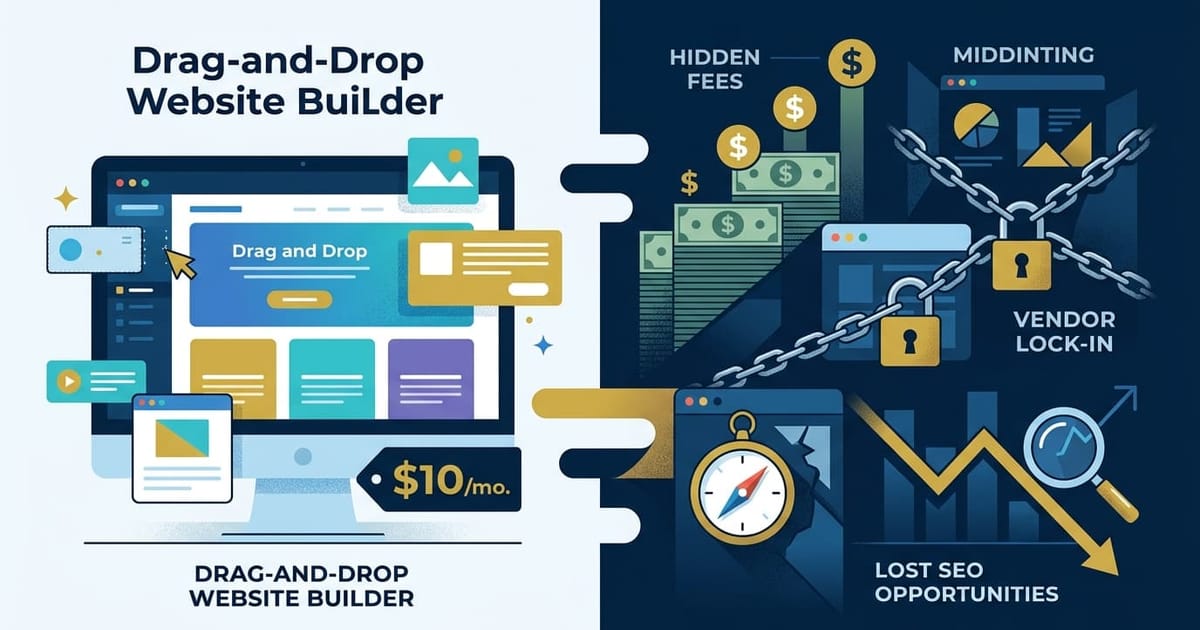
No-code and template website builders like Wix, Squarespace, and Webflow promise fast, cheap, and easy websites. For many small businesses, they deliver exactly that — a functional website in a weekend for under $50. But as your business grows, the hidden costs of these platforms begin to compound. In 2026, with competition fiercer than ever and customer expectations higher than ever, those hidden costs can be the difference between scaling and stagnating. Here is what business owners need to know before committing to a no-code or template solution.
1. Performance Penalties That Kill Conversions
In 2026, page speed is not just a ranking factor — it is a conversion factor. Google research shows that every additional second of load time reduces conversions by 7%. Template websites built on no-code platforms are notoriously slow because they load massive JavaScript bundles, unused CSS, and bloated third-party scripts that you cannot remove.
Wix sites average 4.2 seconds to first contentful paint. Squarespace sites average 3.8 seconds. Custom-built sites optimized by professional developers average 1.2 seconds. That difference translates directly to revenue: a business generating $10,000 per month in online sales loses $700 per month for every second of additional load time. Over a year, that is $8,400 in lost revenue — far more than the cost of a custom build.
And it gets worse. No-code platforms inject their own analytics, cookie banners, and marketing scripts that you cannot disable. These scripts track your visitors for the platform's benefit, not yours, and they slow down your site. You are literally paying — in lost conversions — for the privilege of being spied on.
2. SEO Limitations That Cap Your Growth
Search engine optimization in 2026 is more competitive than ever. Local businesses in San Diego are fighting for the same keywords, and Google rewards sites that load fast, have clean code, and implement structured data correctly. Template websites fail on all three counts.
No-code platforms generate messy, non-semantic HTML that search engines struggle to parse. They limit your ability to add custom schema markup, control meta tags programmatically, or implement advanced SEO strategies like dynamic rendering and edge caching. You cannot edit the robots.txt file, cannot add custom headers, and cannot implement server-side rendering — all standard practices for competitive SEO in 2026.
The result? Your template website hits an SEO ceiling. You might rank for your business name and a few long-tail keywords, but you will never compete for high-value terms like "San Diego web design" or "best contractor in La Jolla." The opportunity cost of lost organic traffic is measured in tens of thousands of dollars per year — and it compounds as your competitors invest in custom builds that outrank you.
3. Vendor Lock-In: The Hotel California of Web Design
The most expensive hidden cost of no-code platforms is vendor lock-in. When you build on Wix, Squarespace, or Webflow, you do not own your website — you rent it. Your content, your design, your customer data, and your SEO history are trapped in their ecosystem. If they raise prices, change terms, or discontinue features, you have no recourse.
In 2025, Wix increased premium plan prices by 25% with 30 days notice. Squarespace removed several e-commerce features that businesses relied on, forcing them to upgrade to more expensive plans. These are not edge cases — they are the business model. No-code platforms profit from your dependency, and they have no incentive to make leaving easy.
When you finally outgrow the platform — and every growing business does — migration is painful and expensive. You cannot export clean code. You lose your SEO rankings because URLs change. You rebuild from scratch, paying twice for what you should have built correctly the first time. The total cost of ownership for a "cheap" template website often exceeds $50,000 over five years when you factor in lost revenue, migration costs, and rebuilds.
4. Scalability Ceilings That Block Growth
Template websites are built for small businesses with simple needs. When your business grows — when you need custom integrations, advanced analytics, membership systems, or multi-language support — the platform breaks down.
No-code platforms offer app marketplaces with third-party integrations, but these are limited, expensive, and often unreliable. A custom CRM integration that takes a developer two hours on a custom site requires a $50/month app on Wix, and it still might not work correctly. Custom checkout flows, advanced filtering, and dynamic content are either impossible or require expensive workarounds.
In 2026, businesses need websites that grow with them. A restaurant that starts with online reservations might need kitchen display systems, loyalty programs, and delivery integrations within a year. A contractor who starts with a portfolio site might need project management portals, client dashboards, and automated invoicing. Template websites cannot scale to meet these needs — and the cost of rebuilding on a proper foundation is always higher than building correctly from day one.
5. The Brand Identity Problem
Your website is your brand's most visible expression. Template websites force your brand into pre-designed boxes that hundreds of other businesses use. When a potential customer visits your site and sees the same template they saw on three competitors' sites, your credibility drops. You look generic, interchangeable, and forgettable.
In 2026, brand differentiation is everything. San Diego's competitive markets — real estate, legal services, hospitality, healthcare — demand websites that communicate unique value propositions, not cookie-cutter layouts. Custom web design ensures your brand stands out, tells your story, and converts visitors into customers. Template websites tell visitors you are willing to settle — and customers can smell that from the homepage.
6. Security and Compliance Risks
No-code platforms are massive targets for hackers. A single vulnerability in Wix or Squarespace affects millions of websites simultaneously. When breaches occur — and they do — your customer data is at risk, and you have no control over the response. You cannot audit the code, cannot implement custom security measures, and cannot guarantee compliance with regulations like CCPA, CPRA, or HIPAA.
Custom websites built on decentralized infrastructure like the Internet Computer Protocol offer quantum-resistant security, full data ownership, and compliance by design. Your data is encrypted, sharded, and replicated across independent nodes. You control access, you control backups, and you control compliance documentation. For businesses handling sensitive information, this is not optional — it is a legal and ethical obligation.
The Real Math: Total Cost of Ownership
Let us look at the five-year total cost of ownership for a typical small business website:
Template Website (Wix/Squarespace):
- Platform fees: $29/month × 60 months = $1,740
- Premium apps and integrations: $50/month × 60 months = $3,000
- Lost conversions from slow speed: ~$8,400/year × 5 = $42,000
- Lost SEO traffic opportunity: ~$15,000/year × 5 = $75,000
- Migration and rebuild when you outgrow: $15,000
- Total: $136,740
Custom Website (Goyim Design Strategies):
- Initial build: $8,000 – $25,000
- Hosting (decentralized, $0): $0
- Maintenance and updates: $200/month × 60 = $12,000
- Lost conversions from optimized speed: minimal
- SEO growth compounding: positive ROI
- Total: $20,000 – $37,000
The template website costs 4–7× more over five years while delivering inferior performance, weaker SEO, and no scalability. The "cheap" option is the most expensive option.
Related Articles
Marcus Belmares
Lead Designer & Founder, Goyim Design Strategies
Marcus Belmares is the founder and lead developer at Goyim Design Strategies, specializing in premium web development, decentralized hosting, and SaaS solutions for San Diego businesses. He writes about the real costs of web design decisions and how to build digital infrastructure that scales.
Ready to Own Your Website?
Stop renting your digital presence. Get a custom-built website with full code ownership, zero hosting fees, and no vendor lock-in.